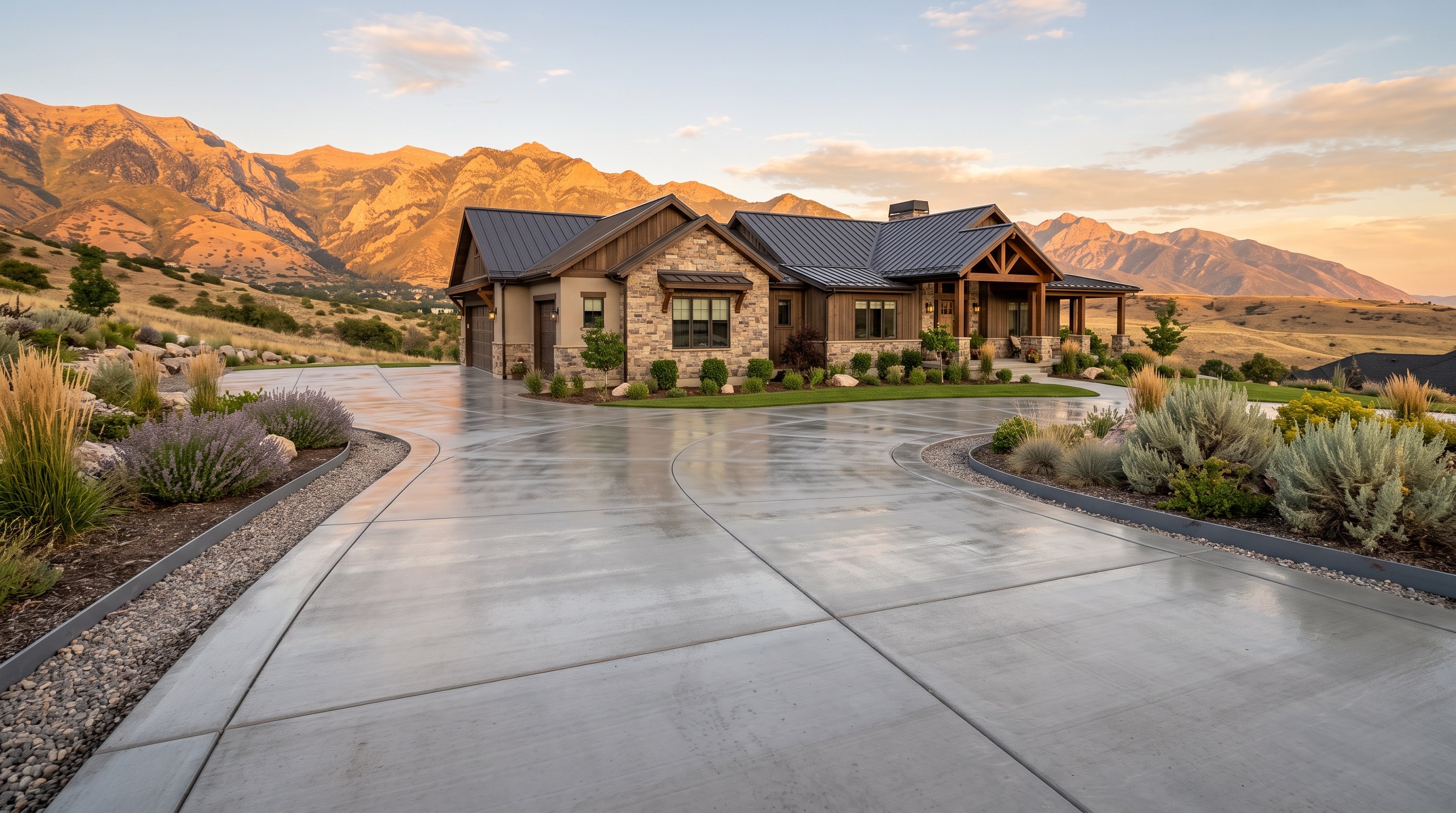
An RV pad, a shop slab, or a footing for an outbuilding is not just a thicker driveway — it carries concentrated weight that will find every weak spot in a base or a reinforcement plan. Do it right and it holds a loaded coach or a metal building for decades; do it cheap and it cracks under the first jack stand. This guide covers what heavy pads and foundations actually need, how Utah's frost line changes the footing work, what it costs, and how to vet the crew. Our on-site estimates are free.
Why a heavy pad is not just a thick driveway
The difference between a standard slab and a load-rated pad or foundation is the weight it has to carry — and how that weight is concentrated. An RV's jacks and a trailer's tongue put point loads on the surface that will crack a thin slab poured on a weak base. So a real heavy pad steps up on every spec that matters.
| Factor | Standard slab | RV pad / foundation |
|---|---|---|
| Thickness | 4 in. | 5 to 6 in.+, thicker for big coaches |
| Base | Compacted road base | Deeper, well-compacted base for point loads |
| Reinforcement | Mesh or light rebar | #4 rebar grid, tighter spacing, chaired up |
| Edges | Uniform slab | Thickened or turned-down edges |
| Footings | None | Below the frost line for structures |
For sheds, shops, and garages, that often means a monolithic slab with thickened edges, or footings and a stem wall for a full structure. Reinforcement and slab-on-ground design standards from the American Concrete Institute are the backbone of getting it right. A crew that asks what you are parking or building before quoting is on the right track.
Utah County ground, frost, and heavy loads
Heavy loads magnify every weakness in the ground, and south Utah County has a few that a pad or foundation has to be built around. This is where cutting corners on the base or the footing depth catches up with you fastest.
- Expansive clay under a point load. The clay soils common on the valley floor already move with moisture; add the concentrated weight of an RV or a building and a thin, poorly based slab settles and cracks. A deep, well-compacted base spreads that load.
- The frost line. Utah County's frost depth runs on the order of 30 inches, and footings for any real structure have to reach below it. A footing poured too shallow heaves as the ground freezes and thaws, taking the wall or post with it — which is why foundation depth is not a place to save money.
- Freeze-thaw and drainage. Air-entrained concrete and a pad graded to shed water keep the surface from scaling and keep water from collecting under the slab and freezing.
One more local note: a simple RV parking pad usually does not need a permit, but structural foundations — footings and stem walls for a shop, garage, or addition — generally do, and sometimes an engineer's stamp. It is worth checking with the Spanish Fork building department before the pour, and a good crew will tell you when a project crosses that line.
What a proper pad or foundation includes
A pad or foundation that carries real weight is built in a sequence, and the cheap bid usually saves money by shorting the base depth, the edge thickening, or the steel:
- Soil and grade check. The crew looks at the ground and how the pad will be loaded, then sets depth and drainage.
- Deep compacted base. Road base is placed and compacted in lifts, deeper than a standard slab, to support concentrated loads.
- Correct thickness. Five to six inches or more, sized to the RV, trailer, or building it will hold.
- Thickened or turned-down edges. The slab edge is deepened where loads concentrate, or footings are formed below the frost line for a structure.
- Heavy reinforcement. A #4 rebar grid on chairs, at tighter spacing than a driveway, tied so it sits inside the slab.
- Freeze-rated mix, proper joints, full cure. Air-entrained concrete, control joints where they belong, and a full 28-day cure before heavy weight goes on.
For structural foundations, permitting and any required engineering are handled before the pour, so the work passes inspection the first time.
What does an RV pad or foundation cost in Spanish Fork?
Load-rated concrete is priced by the square foot, and it runs above a standard driveway because of the added thickness, base, and steel. Structural footings are quoted after a look at the site and any engineering. Industry pricing guides such as the Concrete Network cost data track close to what is typical here.
| Work | Typical range* |
|---|---|
| Reinforced RV pad | $8 – $14 per sq ft |
| Shop or garage slab | $7 – $13 per sq ft |
| Thickened-edge monolithic slab | Priced by size & spec |
| Footings / stem wall | Quoted after review & any engineering |
*Ballpark ranges for reinforced, air-entrained load-rated concrete. Big coaches, extra thickness, deep footings, hard access, and engineered foundations run higher. Your written on-site estimate is the only number that applies to your project.
A pad or foundation is the last place to shop on price alone — the failures here are the expensive kind, involving jacking, tear-out, or a shifted building. The only number that matters is a written estimate for your project, which is why the on-site estimate is free.
How to vet any concrete crew (including us)
Before you pour something that has to carry real weight, ask:
- How thick will the pad be, and what rebar size and spacing, for the load I described?
- How deep is the compacted base, and will you thicken the edges?
- For a structure, how do you handle footings below the frost line?
- Does my project need a permit or engineering, and who pulls it?
- How long before I can park the RV or load the slab — and are you licensed, insured, and quoting in writing?
A crew that asks detailed questions about what you are parking or building, and talks openly about base depth and frost, is the one you want on a load-rated pour.
Spanish Fork RV pad & foundation questions, answered
How thick should an RV pad be?
Five to six inches over a deep, well-compacted base is a common spec for a residential RV pad, with a #4 rebar grid and often thickened edges where the jacks and tires concentrate weight. Bigger coaches and heavier trailers can call for more, which is why the crew asks what you are parking before quoting.
How long before I can park the RV on it?
Give a load-rated pad the full 28 days to reach its design strength before you put a loaded RV or trailer on it. You can walk on it much sooner, but heavy point loads on a green slab are one of the surest ways to crack an otherwise good pour.
Do I need a permit for a pad or foundation?
A simple RV parking pad usually does not need a permit, but a structural foundation — footings and a stem wall for a shop, garage, or addition — generally does, and sometimes an engineer's stamp. It is worth checking with the Spanish Fork building department, and we will flag when a project crosses that line.
How deep do footings need to go here?
Footings for a structure need to reach below the frost line, which in Utah County runs on the order of 30 inches. A footing poured too shallow heaves as the ground freezes and thaws, so proper depth is essential for anything you are building on the concrete rather than just parking on it.
Can you pour a shop or garage slab too?
Yes. Shop and garage slabs, thickened-edge monolithic slabs for metal buildings, and shed footings are all common work, built with the same attention to base, thickness, steel, and frost-depth footings that a good RV pad gets. Bring the building's plans to the estimate if you have them.
Do you serve areas outside Spanish Fork?
Yes — crews regularly pour RV pads, shop slabs, and patios and flatwork in Springville, Salem, Payson, and Mapleton, and across south Utah County.