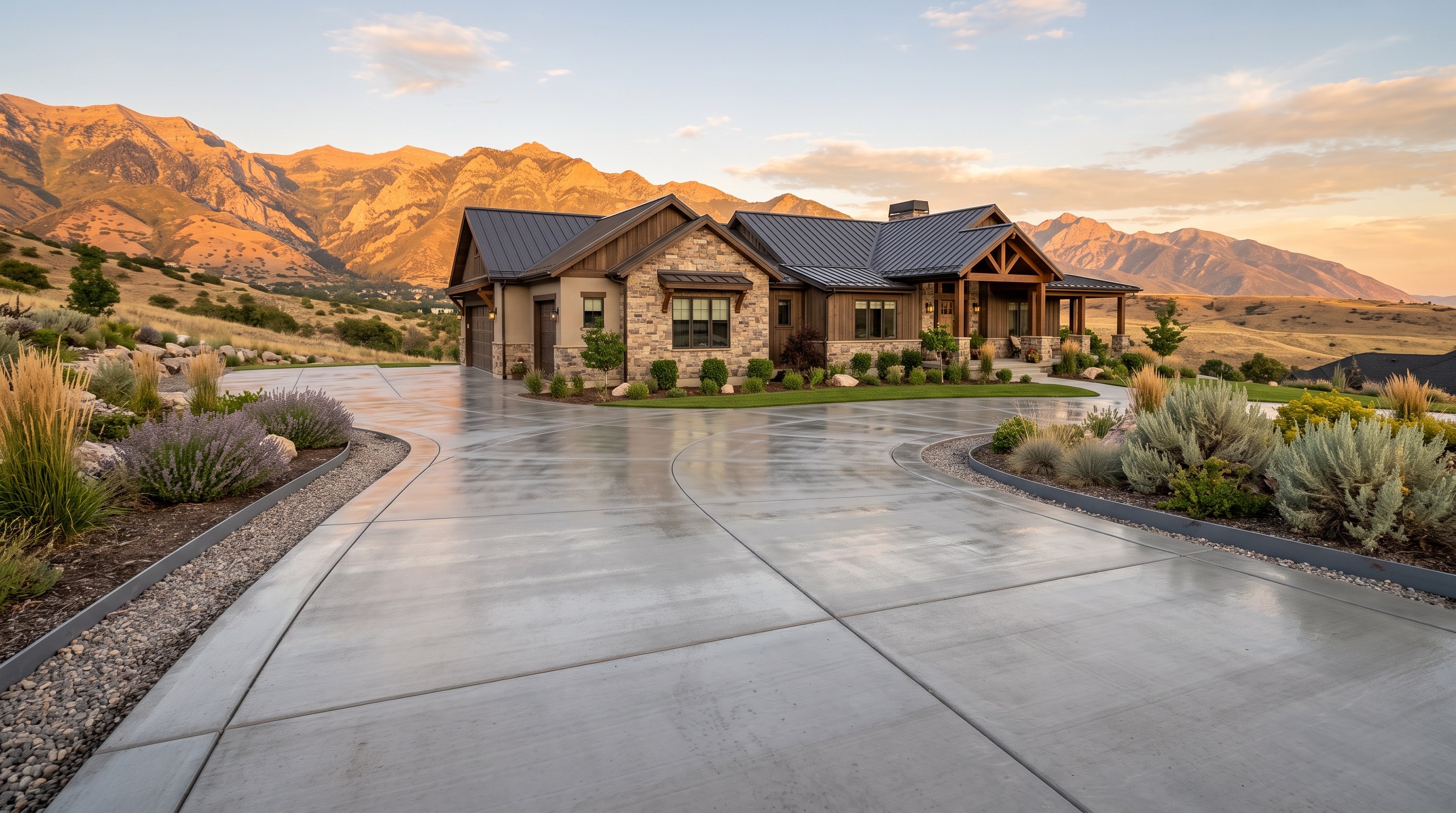
A patio or a run of flatwork is where a lot of a backyard actually gets used, and it is also where a rushed pour shows up fastest — as water pooling against the house, a slab that has settled toward the foundation, or a surface that scales after one winter. Good flatwork comes down to two things most bids gloss over: the finish you will live with, and the grading and base underneath that keep it flat and draining. This guide covers both, what it costs in south Utah County, and how to vet a crew. Our on-site estimates are free.
Patio finishes, and what actually matters
Most residential flatwork in Spanish Fork gets one of a few finishes, and the right one depends on how the space is used and how much upkeep you want. The finish is the part you see — but it is only half the job, and the flashier the finish, the more the base and drainage underneath decide whether it lasts.
| Finish | Look | Slip & upkeep |
|---|---|---|
| Broom | Clean, matte, fine texture lines | High grip; low upkeep, occasional seal |
| Exposed aggregate | Natural pebbled stone look | High grip; reseal periodically |
| Stamped | Reads like stone, slate, or brick | Slicker when wet; reseal every 2–3 yrs |
| Colored / integral | Uniform tone through the slab | Depends on the surface texture |
A broom finish is the durable, budget-friendly standard — slip-resistant and hard to beat for walkways and everyday patios. Exposed aggregate hides wear and grips well underfoot. Stamped and colored work costs more and buys you the look of stone; it is covered in depth on our stamped and decorative concrete page. Whatever the finish, ask what is happening below it.
What south Utah County does to a patio slab
The same climate and soils that challenge a driveway are just as hard on patios and walkways, and a slab sitting right against the house has one extra job: moving water away from the foundation. A few local realities drive how flatwork should be built here.
- Drainage first. Flatwork against the house has to slope away from it — a fall of about a quarter inch per foot keeps rain and snowmelt from pooling at the foundation, where it can seep in or freeze and heave the slab. A patio that drains back toward the house is a problem no finish can fix.
- Expansive clay. The clay soils common on the valley floor swell and shrink with moisture, lifting slabs poured on a thin or uneven base. Compacted road base and correct thickness are the fix.
- Freeze-thaw and dry wind. Utah winters scale concrete that was not air-entrained, and the hot, dry summers and canyon wind pull moisture out of a fresh pour fast. Proper mix and curing are what keep the surface intact.
The other quiet essential is jointing. Isolation joints where the patio meets the house, steps, and posts let the slab move on its own without cracking, and control joints give any shrinkage a planned place to go. Crews pour flatwork this way across Springville, Salem, and Mapleton for the same reason they do in Spanish Fork — the ground and the seasons do not change.
What proper flatwork includes
A patio or walkway that stays flat and dry is built in a sequence, and the low bid usually saves money by skipping the grade work or the curing:
- Layout and drainage slope. The area is formed and graded to fall away from the house and any structures.
- Compacted base. Road base is placed and compacted so the slab is supported evenly across its whole footprint.
- Correct thickness and reinforcement. Patios and walks are typically poured four inches thick with mesh or rebar tied into a grid and chaired up into the slab.
- Isolation and control joints. Isolation joints separate the slab from the house and fixed edges; control joints are cut at proper spacing so cracks stay hidden in the lines.
- Finish and edging. The surface is floated, edged, and given its broom, aggregate, or decorative finish.
- Curing. The slab is kept damp or sealed while it gains strength, so summer heat and wind do not craze the surface.
Most residential patios and walkways are poured in a single visit, with a clear plan for when the surface is ready for foot traffic and furniture.
What does a concrete patio cost in Spanish Fork?
Flatwork is usually priced by the square foot, and the finish plus the site conditions drive the number — grading, tear-out, thickness, and decorative work all add labor. Industry pricing guides such as the Concrete Network cost data track close to what is typical here.
| Job | Typical range* |
|---|---|
| Standard broom-finish patio | $6 – $11 per sq ft |
| Exposed-aggregate patio | $8 – $14 per sq ft |
| Sidewalk or walkway | $6 – $12 per sq ft |
| Stamped / decorative | See the decorative concrete guide |
*Ballpark ranges for standard reinforced, air-entrained flatwork. Small pours often carry a minimum, and tear-out, hard access, and decorative finishes run higher. Your written on-site estimate is the only number that applies to your project.
A patio is one place where the cheapest bid tends to cost the most later — a slab poured on loose dirt, graded flat instead of to drain, is the one that pools water and heaves. The only number that matters is a written estimate for your space, which is why the on-site estimate is free.
How to vet any concrete crew (including us)
Before you hand over a backyard, ask each bidder:
- How will you grade the slab to drain away from the house?
- How much compacted base goes down, and how thick is the slab?
- What reinforcement do you use, and how is it held up in the pour?
- Where will you put isolation and control joints so it does not crack randomly?
- Do you use a freeze-rated mix and cure the surface — and are you licensed, insured, and putting the estimate in writing?
Careful crews welcome these questions. Vague answers, especially about drainage and base, are your cue to keep looking.
Spanish Fork patio & flatwork questions, answered
How thick should a patio be?
Four inches over a compacted base is standard for a residential patio or walkway. What matters just as much is that the base is compacted evenly and the slab is sloped to drain away from the house, so it stays flat and does not send water toward the foundation.
How do you keep water from pooling on the patio?
By building slope into the slab from the start — usually about a quarter inch of fall per foot, away from the house and any structures. Concrete is graded to drain while it is being formed and finished; it cannot be fixed after it cures, which is why the grading step matters so much.
Broom finish or something decorative?
A broom finish is the durable, slip-resistant, budget-friendly standard and is hard to beat for walkways and everyday patios. Exposed aggregate and stamped finishes cost more and give you a stone-like look with a bit more upkeep. We will walk through the trade-offs with your estimate.
Will my patio crack?
All concrete moves, so the goal is to control where any cracks go rather than promise none. Compacted base, reinforcement, and properly spaced control and isolation joints keep shrinkage in the joint lines and let the slab move away from the house without tearing.
How soon can I use it?
You can usually walk on a fresh patio after about 24 hours and put furniture back within a few days. Give the slab time to cure before heavy use, and if it is stamped and sealed, follow the crew's guidance on when the surface is fully ready.
Do you serve areas outside Spanish Fork?
Yes — crews regularly pour patios, walkways, and stamped and decorative flatwork in Springville, Salem, Payson, and Mapleton, and across south Utah County.